Sheet 13/77Products / Steel and structural / Weld neck flangeRev
Steel and structural · catalogue item
Weld neck flange
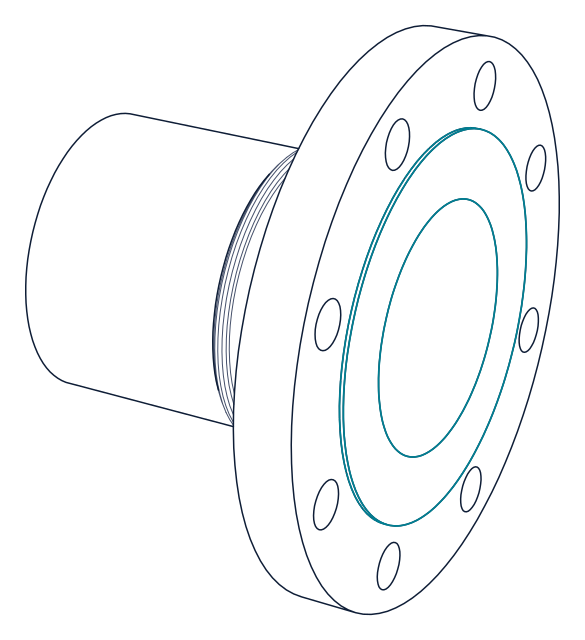
Forged flange with a tapered hub butt welded to the pipe, used in high-pressure and cyclic service.
In short
Forged flange with a tapered hub butt welded to the pipe, used in high-pressure and cyclic service. JJ Projects sources it to the specification the buyer names. Typical reference, standards: ASME B16.5 (to NPS 24), ASME B16.47 (larger sizes).
Specification references
Typical references only. The governing specification is the one on your purchase order or datasheet.
| Property | Typical reference |
|---|---|
| Standards | ASME B16.5 (to NPS 24), ASME B16.47 (larger sizes) |
| Materials | ASTM A105, A350 LF2, A182 (alloy and stainless) |
| Class and face | Class 150 to 2500; raised face or ring-type joint |
| Bore | Matched to the pipe schedule |
Specification references describe what the order names, not a certification held by JJ Projects.
Steel and structural
Typical uses
- 01Piping in high-pressure, high-temperature and cyclic service
- 02Nozzle connections on vessels, exchangers and pumps
- 03Hydrocarbon and other hazardous lines where butt welds are examined by radiography
- 04Joints that must be dismantled for maintenance
What to include in a request
A request with these details can be quoted without a round of questions. Send what you have and we will ask for the rest.
- 01NPS and pressure class, from Class 150 to 2500
- 02Standard: ASME B16.5 up to NPS 24, or ASME B16.47 Series A or Series B for larger sizes
- 03Facing: raised face, flat face or ring-type joint, and the surface finish if specified
- 04Bore or pipe schedule, so the hub matches the pipe it is welded to
- 05Material and grade, for example ASTM A105, A350 LF2 or A182 F316L, with any low-temperature or sour service requirement
- 06Quantity
- 07Documents: material test report, for example EN 10204 type 3.1, and any marking or testing requirement
Steel and structural
Related items
- 01Slip-on flangeForged slip-on flanges to ASME B16.5 in A105 and A182 grades, raised or flat face, and what to state when you request slip-on flanges for a quote.Learn more
- 02Blind flangeForged blind flanges to ASME B16.5 and B16.47 in A105 and A182 grades, Class 150 to 2500, and what to include in a blind flange request for a quote.Learn more
- 03Stud bolt with nutsStud bolts with heavy hex nuts: ASTM A193 B7, B8M and L7 studs with A194 2H nuts for flanged joints, and what to state in the request so it can be quoted.Learn more
- 04Spiral-wound gasketSpiral-wound gaskets to ASME B16.20 with 304 or 316L winding and graphite or PTFE filler, for raised-face flanges, with request details needed to quote.Learn more
Guides
Guides
- 01Flange pressure classes: ASME B16.5 and B16.47How ASME flange classes 150 to 2500 work: B16.5 vs B16.47, pressure-temperature ratings, facings RF, FF and RTJ, flange types and common materials.Learn more
- 02Stud bolts and gaskets: ASTM A193 and A320How to specify flange bolting and gaskets: ASTM A193 B7, B7M, B8, A194 2H and 2HM nuts, A320 L7, coatings and spiral-wound gaskets to ASME B16.20.Learn more
- 03Pipe schedules: NPS, OD and wall thicknessNPS is a label, not a measurement. Learn how pipe schedule sets wall thickness under ASME B36.10M and B36.19M, with OD and wall tables for NPS 2, 4, 6 and 8.Learn more
Questions
Questions
01Why must I state the pipe schedule for a weld neck flange?
The bore of a weld neck flange is machined to match the inside diameter of the pipe it joins, so the schedule or wall thickness fixes the bore. A wrong bore leaves a step at the weld that disturbs flow and welding.
02When is a weld neck flange chosen over a slip-on?
The tapered hub carries stress smoothly into the pipe, so weld neck flanges are the usual choice for high pressure, high temperature, cyclic loading and hazardous fluids. Slip-on flanges are easier to align but are limited by many piping specifications.
03What is the difference between B16.47 Series A and Series B?
Both cover large-diameter flanges above NPS 24. Series A flanges are heavier and Series B are lighter, with different bolt circles, so a Series A flange does not mate with a Series B flange of the same size and class.
Send the specification. We will take it from there.
A material list, a drawing or a single line: tell us what the project needs and where it is going.