Transcript
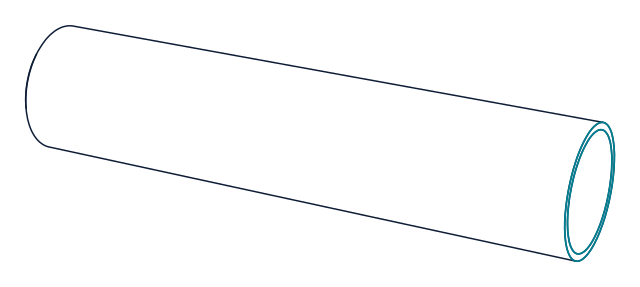
Pipe schedule for NPS 4, sourced to ASME B36.10M. The outside diameter is fixed at 4.500 inches (114.3 millimetres) for every schedule; the schedule changes the wall thickness, so the bore gets smaller as the wall gets thicker. Schedule 10: wall 0.120 inch (3.05 mm), inside diameter 4.260 inches. Schedule 40, also standard weight: 0.237 inch (6.02 mm), inside diameter 4.026 inches. Schedule 80, also extra strong: 0.337 inch (8.56 mm), inside diameter 3.826 inches. Schedule 120: 0.438 inch (11.13 mm), inside diameter 3.624 inches. Schedule 160: 0.531 inch (13.49 mm), inside diameter 3.438 inches. Double extra strong: 0.674 inch (17.12 mm), inside diameter 3.152 inches. Inside diameters are derived from the outside diameter and the wall. Confirm values against the current edition of the standard before design.
What does NPS mean, and how does it relate to OD?
- NPS (nominal pipe size)
- A North American designation for pipe size. The number is a label; it does not equal any measured diameter for sizes below NPS 14.
Below NPS 14, the outside diameter is larger than the NPS number. NPS 4 pipe has an OD of 4.500 in (114.3 mm). From NPS 14 upward, the NPS number equals the OD in inches.
The OD is fixed for each NPS across every schedule. This is what lets fittings, flanges and valves fit pipe of any wall thickness: only the bore changes.
The metric equivalent is DN (diameter nominal). NPS 2, 4, 6 and 8 correspond to DN 50, 100, 150 and 200.
What is a pipe schedule?
- Schedule (SCH)
- A designation, such as 40 or 80, that fixes the nominal wall thickness of a pipe for a given NPS.
The schedule number is a label, like NPS. The same schedule gives different wall thicknesses at different NPS, so you always read the wall from a table for that size.
Three older designations remain in use. STD (standard weight), XS (extra strong) and XXS (double extra strong) predate schedule numbers. For sizes up to NPS 10, STD equals SCH 40. XS equals SCH 80 up to NPS 8. XXS has no schedule number. At larger sizes these designations diverge from the schedule numbers, so check the table.
A suffix “S”, as in 10S or 40S, marks stainless steel schedules in ASME B36.19M.
What are the OD and wall thickness for NPS 2, 4, 6 and 8?
The table gives the nominal wall for the most-requested schedules. Values are from ASME B36.10M. For these sizes, SCH 10 has the same wall as 10S in ASME B36.19M.
| NPS | OD, in (mm) | SCH 10 | SCH 40 | SCH 80 | SCH 160 | XXS |
|---|---|---|---|---|---|---|
| 2 | 2.375 (60.3) | 0.109 in (2.77 mm) | 0.154 in (3.91 mm) | 0.218 in (5.54 mm) | 0.344 in (8.74 mm) | 0.436 in (11.07 mm) |
| 4 | 4.500 (114.3) | 0.120 in (3.05 mm) | 0.237 in (6.02 mm) | 0.337 in (8.56 mm) | 0.531 in (13.49 mm) | 0.674 in (17.12 mm) |
| 6 | 6.625 (168.3) | 0.134 in (3.40 mm) | 0.280 in (7.11 mm) | 0.432 in (10.97 mm) | 0.718 in (18.24 mm) | 0.864 in (21.95 mm) |
| 8 | 8.625 (219.1) | 0.148 in (3.76 mm) | 0.322 in (8.18 mm) | 0.500 in (12.70 mm) | 0.906 in (23.01 mm) | 0.875 in (22.23 mm) |
At NPS 8, XXS (0.875 in) is thinner than SCH 160 (0.906 in). Do not assume that XXS is always the heaviest wall.
Transcript
Pipe schedule for NPS 4, sourced to ASME B36.10M. The outside diameter is fixed at 4.500 inches (114.3 millimetres) for every schedule; the schedule changes the wall thickness, so the bore gets smaller as the wall gets thicker. Schedule 10: wall 0.120 inch (3.05 mm), inside diameter 4.260 inches. Schedule 40, also standard weight: 0.237 inch (6.02 mm), inside diameter 4.026 inches. Schedule 80, also extra strong: 0.337 inch (8.56 mm), inside diameter 3.826 inches. Schedule 120: 0.438 inch (11.13 mm), inside diameter 3.624 inches. Schedule 160: 0.531 inch (13.49 mm), inside diameter 3.438 inches. Double extra strong: 0.674 inch (17.12 mm), inside diameter 3.152 inches. Inside diameters are derived from the outside diameter and the wall. Confirm values against the current edition of the standard before design.
How do you calculate the bore of a pipe?
Subtract two wall thicknesses from the OD. For NPS 4 SCH 40, the bore is 4.500 − 2 × 0.237 = 4.026 in. For NPS 4 SCH 80, it is 4.500 − 2 × 0.337 = 3.826 in.
A heavier schedule raises pressure capacity and corrosion allowance, and it lowers flow area and raises weight. The right schedule comes from the design pressure, temperature, corrosion allowance and piping code, not from a rule of thumb.
How do you choose a schedule?
The piping designer calculates a minimum required thickness under the governing code, for example ASME B31.3 for process piping. The calculation includes design pressure, temperature, material strength, corrosion allowance and mill tolerance. The designer then selects the next commercially available wall that exceeds it.
- Mill tolerance. Seamless carbon steel pipe may be supplied with a wall up to 12.5 % under nominal (ASTM A530 / A106). The calculation must account for it.
- Corrosion allowance. An added thickness the designer chooses for service life.
- Fittings and flanges. Weld-neck flanges and butt-weld fittings must be bored or bevelled to match the pipe schedule you order.
State the schedule on every pipe, fitting and weld-neck flange in the RFQ. See How to write an RFQ.
Which standards cover pipe dimensions and materials?
| Standard | What it covers |
|---|---|
| ASME B36.10M | Dimensions of welded and seamless wrought steel pipe: carbon, alloy and ferritic stainless steel |
| ASME B36.19M | Dimensions of stainless steel pipe, with “S” schedules |
| ASTM A106 | Seamless carbon steel pipe for high-temperature service (Grades A, B, C) |
| ASTM A53 | Black and hot-dipped zinc-coated welded and seamless steel pipe |
| ASTM A312 | Seamless, welded and heavily cold worked austenitic stainless steel pipe |
| ASTM A333 | Seamless and welded steel pipe for low-temperature service |
B36.10M and B36.19M give dimensions. The ASTM specification gives material, manufacture and testing. A complete pipe call-out names both.
How can JJ Projects help?
JJ Projects sources line pipe, process tubing, fittings and flanges to specifications such as ASME B36.10M and ASTM A106. Send NPS, schedule, grade, quantity and required documents through Request a quote, or see steel and structural products.
Sources
- ASME B36.10M, Welded and Seamless Wrought Steel Pipe (2022 edition table of contents)
- ASME B36.19M, Stainless Steel Pipe
- Engineering ToolBox, ASME/ANSI B36.10/19 pipe dimensions, metric units
- Engineering ToolBox, nominal wall thickness of pipe (ANSI B36.10)
- ASTM A106/A106M, Seamless Carbon Steel Pipe for High-Temperature Service
- ASTM A530/A530M, General Requirements for Specialized Carbon and Alloy Steel Pipe