Transcript
Pressure ratings of ASME B16.5 flanges for material group 1.1, which includes carbon steel such as ASTM A105, in bar. At ambient temperature, 38 degrees Celsius, classes 150, 300, 600, 900, 1500 and 2500 are rated 19.6, 51.1, 102.1, 153.2, 255.3 and 425.5 bar. As the temperature rises, every class loses capacity. At 400 degrees Celsius the same classes are rated 6.5, 34.7, 69.4, 104.2, 173.6 and 289.3 bar. Class 150 falls to about one third of its ambient rating. The values are the group 1.1 working-pressure ratings up to 400 degrees; confirm them against the current edition of ASME B16.5 before design.
What is a flange pressure class?
- Pressure class
- A numbered rating designation in ASME B16.5 and B16.47, such as Class 300. The allowable working pressure for each class is given by a pressure-temperature table for each material group.
Class 150 does not mean 150 psi. A Class 150 carbon steel flange is rated at 285 psig at ambient temperature (up to 100 °F, 38 °C), and the rating drops as temperature rises. The class number groups flanges of a similar dimensional family.
ASME B16.5 lists seven classes: 150, 300, 400, 600, 900, 1500 and 2500. Class 2500 is limited to NPS 12 and smaller.
Transcript
Pressure ratings of ASME B16.5 flanges for material group 1.1, which includes carbon steel such as ASTM A105, in bar. At ambient temperature, 38 degrees Celsius, classes 150, 300, 600, 900, 1500 and 2500 are rated 19.6, 51.1, 102.1, 153.2, 255.3 and 425.5 bar. As the temperature rises, every class loses capacity. At 400 degrees Celsius the same classes are rated 6.5, 34.7, 69.4, 104.2, 173.6 and 289.3 bar. Class 150 falls to about one third of its ambient rating. The values are the group 1.1 working-pressure ratings up to 400 degrees; confirm them against the current edition of ASME B16.5 before design.
What is the difference between ASME B16.5 and B16.47?
| Standard | Size range | Classes | Notes |
|---|---|---|---|
| ASME B16.5 | NPS 1/2 to NPS 24 | 150, 300, 400, 600, 900, 1500, 2500 | Pipe flanges and flanged fittings; covers weld neck, slip-on, socket weld, threaded, lap joint and blind flanges |
| ASME B16.47 Series A | NPS 26 to NPS 60 | 75 to 900 (classes vary by series) | Large-diameter flanges; dimensions trace to MSS SP-44; larger and heavier than Series B |
| ASME B16.47 Series B | NPS 26 to NPS 60 | 75 to 900 (classes vary by series) | Large-diameter flanges; dimensions trace to API 605; more compact, with smaller bolt circles |
Series A and Series B flanges of the same size and class are generally not interchangeable. State the series in the RFQ. Check the classes offered in each series in the current edition.
B16.47 uses the same pressure-temperature ratings logic as B16.5. For large lines, Series A and Series B are a design decision, not a supplier preference.
How do pressure-temperature ratings work?
A flange's allowable pressure depends on three things: its class, its material group and the operating temperature. The standard publishes a table for each material group. Read down to your design temperature and across to your class.
The table below shows Group 1.1 carbon steel (for example forged A105 and low-temperature A350 LF2), working pressure in bar gauge.
| Temperature | Class 150 | Class 300 | Class 400 | Class 600 | Class 900 | Class 1500 | Class 2500 |
|---|---|---|---|---|---|---|---|
| −29 to 38 °C | 19.6 | 51.1 | 68.1 | 102.1 | 153.2 | 255.3 | 425.5 |
| 100 °C | 17.7 | 46.6 | 62.1 | 93.2 | 139.8 | 233.0 | 388.3 |
| 200 °C | 13.8 | 43.8 | 58.4 | 87.6 | 131.4 | 219.0 | 365.0 |
| 300 °C | 10.2 | 39.8 | 53.1 | 79.6 | 119.5 | 199.1 | 331.8 |
| 400 °C | 6.5 | 34.7 | 46.3 | 69.4 | 104.2 | 173.6 | 289.3 |
Values reproduce Table 2-1.1 as published by the Engineering ToolBox. For design, use the table in the edition of ASME B16.5 your specification cites.
At ambient temperature the Group 1.1 ratings are 285 psig for Class 150, 740 for Class 300, 1480 for Class 600, 2220 for Class 900, 3705 for Class 1500 and 6170 for Class 2500. Note how Class 150 falls from 19.6 to 6.5 bar between ambient and 400 °C, a loss of about two thirds.
Stainless steel has its own tables. At ambient temperature, a Class 150 flange in A182 F304 or F316 is rated 19.0 bar (275 psig), against 19.6 bar for carbon steel. Low-carbon grades such as F316L sit in a different material group with lower ratings, so check the table for the exact grade.
What are RF, FF and RTJ flange facings?
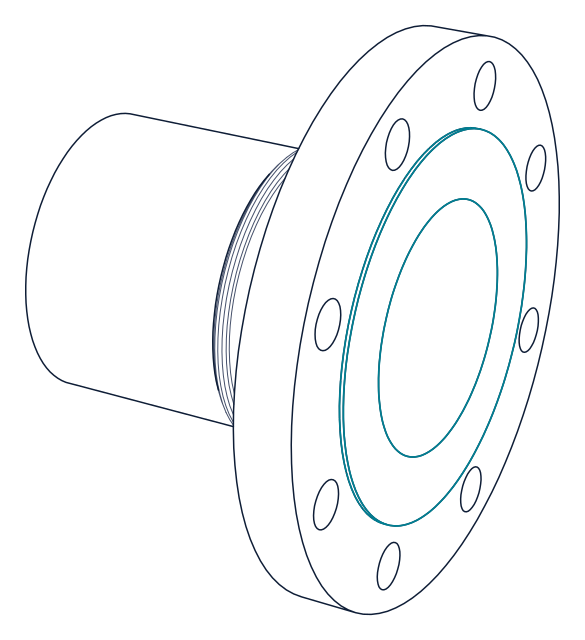
- Raised face (RF). The gasket seats on a raised ring inside the bolt circle. RF is the most common facing on ASME B16.5 flanges in process piping and works with spiral-wound and sheet gaskets.
- Flat face (FF). The whole flange face is flat. FF mates with another flat-face flange, usually with a full-face gasket, and is common on cast iron and low-pressure connections. Do not mate an FF flange with an RF flange.
- Ring-type joint (RTJ). A machined groove in the face takes a metal ring gasket (oval or octagonal). RTJ suits high pressure and temperature, and is common at Class 600 and above. Ring gaskets are covered by ASME B16.20.
State the facing on every flange line, and on valve ends. A mismatch is a field problem that no gasket fixes.
What flange types are there?
| Type | Abbrev. | Joint | Typical use |
|---|---|---|---|
| Weld neck | WN | Butt weld to pipe | Higher pressure and temperature, cyclic or critical service; bore matches the pipe schedule |
| Slip-on | SO | Fillet weld inside and outside | Lower-pressure, non-critical lines; lower cost and easier fit-up |
| Socket weld | SW | Fillet weld at the hub | Small-bore lines |
| Threaded | THD | Threaded to pipe, no weld | Small-bore, non-welded connections |
| Lap joint | LJ | Loose flange on a stub end | Systems that need easy alignment and disassembly |
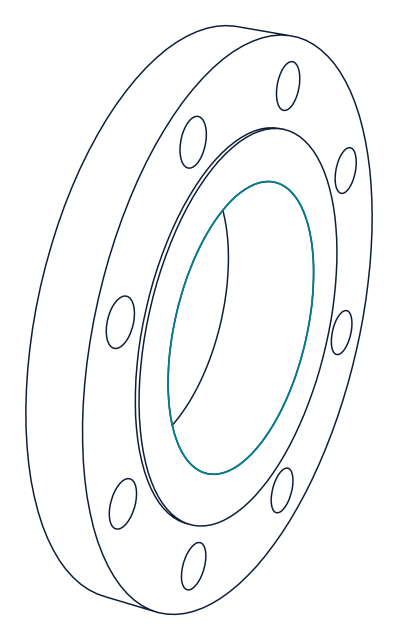
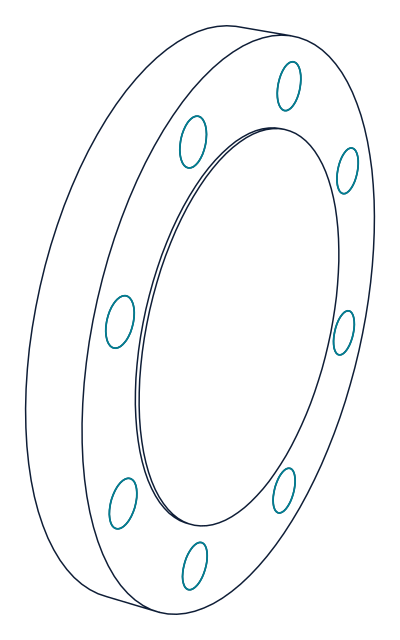
| Blind | BL | Bolted; no bore | Closes the end of a line or a nozzle |
For a weld-neck flange, give the schedule of the mating pipe so the bore matches. See Pipe schedules explained.
Which materials are common for forged flanges?
| Specification | Material | Typical use |
|---|---|---|
| ASTM A105 | Carbon steel forgings for piping | General service in ambient and elevated temperature |
| ASTM A350 LF2 | Carbon steel forgings with notch toughness | Low-temperature service |
| ASTM A182 F304 / F304L | Austenitic stainless steel forgings | Corrosive service; general stainless use |
| ASTM A182 F316 / F316L | Austenitic stainless steel with molybdenum | Chloride-bearing or more corrosive service |
| ASTM A182 F51 / F53 | Duplex and super duplex stainless | High-strength, high-chloride service |
The examples describe typical use only. The design basis decides the material.
Match the flange to the pipe, the valves and the bolting. The guide Stud bolts and gaskets explains how.
How do you specify a flange in an RFQ?
Give type, size, class, facing, bore (for weld neck), standard and material in one line. For example: Flange, weld neck, NPS 4, Class 300, RF, bore SCH 80, ASME B16.5, ASTM A105.
Add the documents you need, such as EN 10204 3.1 certificates, and any supplementary requirements such as impact testing or NACE MR0175 / ISO 15156 compliance. The guide How to write an RFQ covers the full list.
How can JJ Projects help?
JJ Projects sources flanges, fittings, bolting and gaskets to specifications such as ASME B16.5 and ASTM A105. Send your list through Request a quote, or see steel and structural products and valves and process equipment.
Sources
- ASME B16.5, Pipe Flanges and Flanged Fittings: NPS 1/2 through NPS 24
- ASME B16.47, Large Diameter Steel Flanges: NPS 26 through NPS 60
- Engineering ToolBox, Group 1.1 carbon steel flange pressure-temperature ratings (ASME B16.5 Table 2-1.1)
- Fike technical bulletin on ASME B16.5 (2017) pressure-temperature ratings, Groups 1.1, 2.1 and 2.2
- ASME B16.20, Metallic Gaskets for Pipe Flanges
- ASTM A105, A182 and A350 forged flange material specifications