What is a stud bolt and how does it differ from a bolt?
- Stud bolt
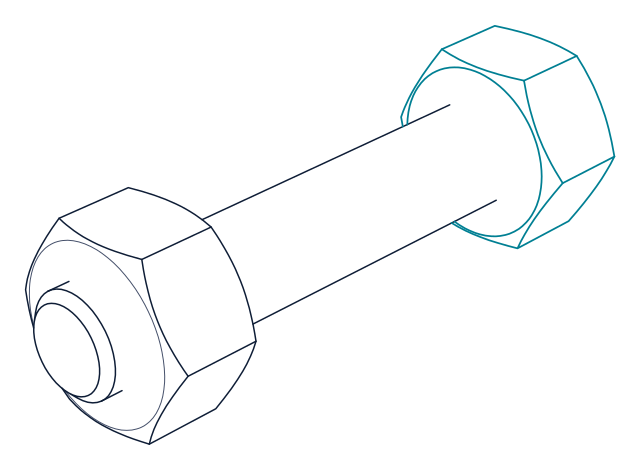
- A fully threaded rod with a thread on both ends or along its full length, used with a nut at each end to clamp a flanged joint.
Flanged joints in process piping normally use stud bolts with two heavy hex nuts, rather than hex-head bolts. Studs give even loading and allow the joint to be assembled and removed from either side.
Flange bolting uses ASME B1.1 unified threads: UNC up to 1 in diameter and the 8-thread series above 1 in. State diameter, thread series, length and quantity per stud set.
What do ASTM A193 B7, B7M, B8 and A320 L7 mean?
| Stud grade | Material | Main use | Matching nut |
|---|---|---|---|
| A193 B7 | Chromium-molybdenum alloy steel, quenched and tempered (AISI 4140 or 4142) | General high-temperature and high-pressure service | A194 2H |
| A193 B7M | As B7, with lower strength and controlled hardness (235 HBW maximum) | Sour service, together with a hardness-controlled nut | A194 2HM |
| A193 B8 Class 1 | 304 stainless steel, solution treated | Corrosive service, moderate strength | A194 Grade 8 |
| A193 B8M Class 1 | 316 stainless steel, solution treated | More corrosive service, including chloride exposure | A194 Grade 8M |
| A320 L7 | Alloy steel like B7, with impact testing at −150 °F (−101 °C) | Low-temperature service | A194 Grade 4 or 7 |
Grade, size and class affect strength. For B7, the minimum tensile strength is 125 ksi and minimum yield strength is 105 ksi up to 2-1/2 in diameter. Check the specification for larger diameters and for B8 Class 2 (strain hardened) grades.
B7 is the default for carbon steel flanges at moderate and high temperature. Below about −20 °F (−29 °C), specify L7, which is impact tested.
B7M is for sour service. Its reduced hardness helps meet hardness limits in standards such as NACE MR0175 / ISO 15156. Use it with 2HM nuts, and do not substitute B7.
B8 and B8M resist corrosion but have lower strength than B7. Check that the joint can reach its required bolt load with the lower strength before you choose them.
What about nuts, coatings and marking?
- Nuts. ASTM A194 specifies heavy hex nuts. 2H is quenched and tempered carbon steel; 2HM is hardness-controlled for sour service. Never pair a nut of a lower grade with a higher-grade stud.
- Coatings. Options include plain (oiled or black), zinc plating, hot-dip galvanizing and fluoropolymer coating. Coatings protect against corrosion and affect friction at assembly, so state the coating and its temperature limit in the RFQ.
- Marking. Studs and nuts carry their grade and manufacturer's identification. Marking lets inspectors check bolting on site against the PO.
- Certificates. Ask for EN 10204 3.1 certificates traceable to heat numbers. See Material test reports.
Joint assembly is as important as bolt grade. ASME PCC-1 gives guidelines for assembling pressure boundary bolted flange joints, including tightening patterns and target bolt loads.
Which gasket types are used between flanges?
| Type | Standard | Description | Typical use |
|---|---|---|---|
| Non-metallic flat (sheet) | ASME B16.21 | Flat gaskets cut from compressed sheet, rubber or PTFE | Lower-pressure, lower-temperature service; flat-face and raised-face flanges |
| Spiral-wound | ASME B16.20 | Metal strip wound in a V-shape with soft filler between turns, with a centering ring and optionally an inner ring | Process piping on raised-face flanges, wide pressure and temperature range |
| Ring-joint (RTJ) | ASME B16.20 | Solid metal ring, oval or octagonal | High-pressure, high-temperature service on RTJ flanges |
| Metal jacketed | ASME B16.20 | Soft filler wrapped in a metal jacket | Heat exchangers and other special joints |
The gasket must suit the flange facing. Sheet gaskets go on raised-face flanges, or full-face on flat-face flanges. Spiral-wound gaskets go on raised-face flanges. Ring gaskets go in the grooves of RTJ flanges. See Flange pressure classes for facings.
How is a spiral-wound gasket built and specified?
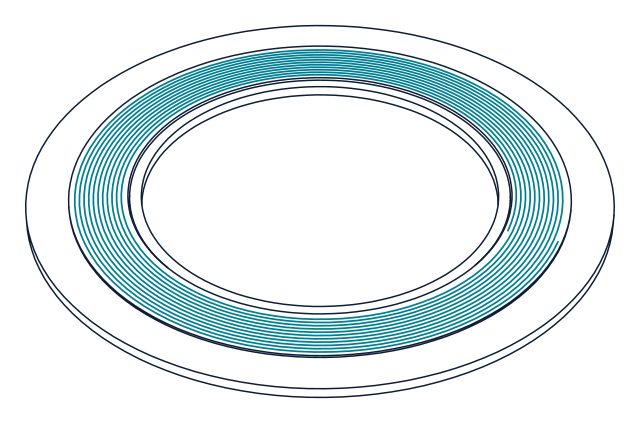
A spiral-wound gasket has a winding of a V-shaped metal strip alternating with a soft filler, usually flexible graphite or PTFE. A carbon steel outer ring (centering ring) locates the gasket in the bolt circle. An inner ring supports the winding on the bore side.
- Winding metal. Typically 304, 316L or a higher alloy, chosen for the fluid and temperature.
- Filler. Flexible graphite for high temperature, PTFE for chemical resistance.
- Inner ring. Required by ASME B16.20 with PTFE filler, and in certain size and class combinations. It also prevents the winding from buckling into the pipe bore.
- Dimensions. By NPS, class and facing, per ASME B16.20.
A typical call-out reads: Gasket, spiral-wound, NPS 4, Class 300, RF, 316L winding, flexible graphite filler, carbon steel outer ring, 316L inner ring, ASME B16.20.
| Element | Colour |
|---|---|
| 304 stainless steel winding | Yellow |
| 316L stainless steel winding | Green |
| Flexible graphite filler | Gray stripe |
| PTFE filler | White stripe |
Colour codes follow common industry practice described in ASME B16.20. Confirm the full code and your supplier's marking against the standard, because manufacturers apply the code on the outer ring and stripe.
What mistakes should you avoid?
- Using a spiral-wound gasket without an inner ring where the standard or service requires one
- Reusing a gasket after a joint has been opened
- Fitting a spiral-wound gasket to a flat-face flange
- Pairing B7M studs with 2H nuts in sour service
- Selecting B8 studs without checking available bolt load
- Ordering bolting by length alone, without allowing for flange, gasket and nut thickness
State bolting and gasket details line by line in the RFQ. The guide How to write an RFQ shows the format.
How can JJ Projects help?
JJ Projects supplies studs, nuts and gaskets as part of flange and piping packages, sourced to specifications such as ASTM A193, ASTM A194 and ASME B16.20. Send a list through Request a quote or see steel and structural products.
Sources
- ASTM A193/A193M, Alloy-Steel and Stainless Steel Bolting for High Temperature or High Pressure Service and Other Special Purpose Applications
- ASTM A194/A194M, Carbon Steel, Alloy Steel, and Stainless Steel Nuts for Bolts for High Pressure or High Temperature Service, or Both
- ASTM A320/A320M, Alloy-Steel and Stainless Steel Bolting for Low-Temperature Service
- Portland Bolt, ASTM A193 and ASTM A320 technical specifications
- Wermac, A193 B7 and A320 L7 studs
- ASME B16.20, Metallic Gaskets for Pipe Flanges: Ring-Joint, Spiral-Wound, and Jacketed
- ASME B16.21, Nonmetallic Flat Gaskets for Pipe Flanges
- ASME PCC-1, Pressure Boundary Bolted Flange Joint Assembly
- HexTechnology, Spiral wound gaskets explained