Sheet 28/77Products / Valves and process equipment / Horizontal separatorRev
Valves and process equipment · catalogue item
Horizontal separator
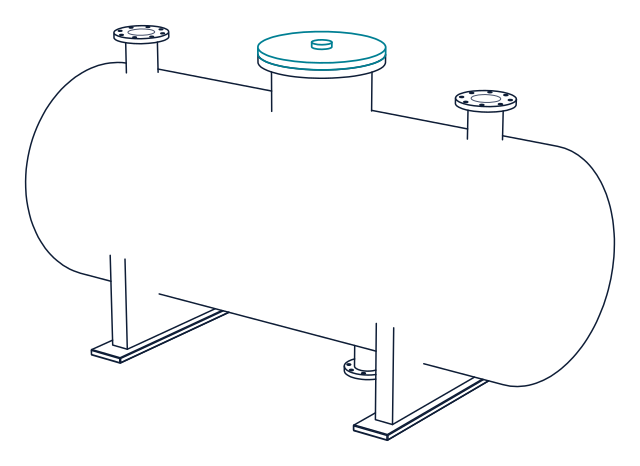
Pressure vessel that separates gas, oil and water by gravity and internals, fabricated to a datasheet.
In short
Pressure vessel that separates gas, oil and water by gravity and internals, fabricated to a datasheet. JJ Projects sources it to the specification the buyer names. Typical reference, standards: ASME Section VIII; nozzles per ASME B16.5.
Specification references
Typical references only. The governing specification is the one on your purchase order or datasheet.
| Property | Typical reference |
|---|---|
| Standards | ASME Section VIII; nozzles per ASME B16.5 |
| Fabrication | To the buyer's datasheet and drawings |
| Internals | As the process datasheet specifies |
| Documents | Data book with drawings, certificates and test reports |
Specification references describe what the order names, not a certification held by JJ Projects.
Valves and process equipment
Typical uses
- 01Oil and gas production: separating gas, oil and water
- 02Gas conditioning, such as knockout and scrubbing upstream of compressors
- 03Pre-separation ahead of treatment and stabilization
- 04Slug handling at the inlet of processing facilities
What to include in a request
A request with these details can be quoted without a round of questions. Send what you have and we will ask for the rest.
- 01Process datasheet: fluids, flow rates, operating pressure and temperature, and separation requirements
- 02Design code, ASME Section VIII Division 1 unless stated, with design pressure and temperature and minimum design metal temperature
- 03Size: inside diameter and tangent-to-tangent length, if set by the datasheet
- 04Materials, corrosion allowance and any sour service requirement
- 05Nozzle schedule with sizes, flange classes and facings
- 06Internals: inlet device, mist eliminator, weirs, vortex breakers, as the process design requires
- 07Code stamp, inspection and testing, third-party inspection, painting, and the data book content
Valves and process equipment
Related items
- 01Shell-and-tube heat exchangerShell-and-tube heat exchangers fabricated to your thermal datasheet to TEMA and ASME Section VIII, and what the request needs, by TEMA type and tubes.Learn more
- 02Weld neck flangeForged weld neck flanges to ASME B16.5 and B16.47 in A105, A350 LF2 and A182 grades, and what a flange request needs to state to be quoted properly.Learn more
- 03Gate valveSteel gate valves to API 600, API 602 and ASME B16.34, tested to API 598, with the specification references and what a gate valve request should include.Learn more
- 04Centrifugal pumpCentrifugal process pumps to API 610 and ASME B73.1, supplied to your datasheet, and what a request needs: fluid, flow, head, NPSH available and materials.Learn more
All valves and process equipment
Guides
Guides
- 01Industrial procurement process, step by stepHow industrial procurement works, step by step: requirement, RFQ, bid tabulation, evaluation, award, PO, expediting, inspection, logistics and delivery.Learn more
- 02How to write an RFQ for industrial materialsWhat an RFQ for industrial materials must specify: item, size, schedule or class, grade, standard, quantity, MTRs, inspection, packing and Incoterm.Learn more
- 03Material test reports (MTRs) and EN 10204What a material test report contains, how EN 10204 types 2.1, 2.2, 3.1 and 3.2 differ, what heat numbers mean, and what to check against the purchase order.Learn more
Questions
Questions
01When is a horizontal separator chosen over a vertical one?
A horizontal vessel has a large gas-liquid interface and is common where liquid volume is large, for three-phase separation or foaming service. A vertical vessel suits high gas-to-liquid ratios and limited plot space. The process engineer makes that call in the datasheet.
02Do you design the separator?
Fabricated equipment is sourced from fabricators to your datasheet and drawings. Sizing and process design come from your datasheet, and detailed mechanical design is done under the code by the fabricator, as the request defines.
03What documents come with a pressure vessel?
Typically a data book with approved drawings, material certificates, welding and inspection records and test reports. The content is agreed in the request and written into the purchase order.
Send the specification. We will take it from there.
A material list, a drawing or a single line: tell us what the project needs and where it is going.