Sheet 24/77Products / Valves and process equipment / Globe valveRev
Valves and process equipment · catalogue item
Globe valve
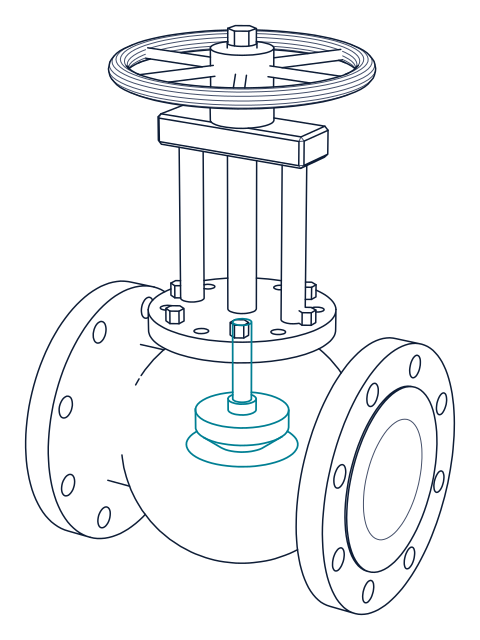
Linear-motion valve with a plug and seat that regulates flow and shuts off tightly, at the cost of higher pressure drop.
In short
Linear-motion valve with a plug and seat that regulates flow and shuts off tightly, at the cost of higher pressure drop. JJ Projects sources it to the specification the buyer names. Typical reference, standards: BS 1873 and API 623 (steel), API 602 (compact), ASME B16.34.
Specification references
Typical references only. The governing specification is the one on your purchase order or datasheet.
| Property | Typical reference |
|---|---|
| Standards | BS 1873 and API 623 (steel), API 602 (compact), ASME B16.34 |
| Testing | API 598 |
| End connections | Flanged, butt-weld, threaded or socket-weld |
| Patterns | Globe and angle |
Specification references describe what the order names, not a certification held by JJ Projects.
Valves and process equipment
Typical uses
- 01Regulating and throttling flow, including bypass lines
- 02Steam, condensate and hot oil lines where tight shutoff and control are both needed
- 03Drain, vent and sample connections on process equipment
- 04Small bore lines in plant utilities
What to include in a request
A request with these details can be quoted without a round of questions. Send what you have and we will ask for the rest.
- 01NPS and pressure class, or the design pressure and temperature
- 02Standard: BS 1873 or API 623 for steel globe valves, API 602 for compact valves, or the one your specification names
- 03Pattern: globe (straight) or angle
- 04Body material and trim, for example carbon steel with 13Cr trim
- 05End connections: flanged, butt-weld, threaded or socket-weld
- 06Operator and stem arrangement, plus any bellows seal or low-emission packing requirement
- 07Service fluid, flow direction and testing, for example API 598, with the documents required
Valves and process equipment
Related items
- 01Gate valveSteel gate valves to API 600, API 602 and ASME B16.34, tested to API 598, with the specification references and what a gate valve request should include.Learn more
- 02Needle valveNeedle valves in forged A105 carbon or A182 F316 stainless steel with NPT, socket-weld or tube ends for instrument and sample lines; request details.Learn more
- 03Ball valveQuarter-turn ball valves to API 608 and API 6D with ASME B16.34 ratings, two-way or three-way, and what to include in a ball valve request to quote.Learn more
- 04Swing check valveSwing check valves to API 594, API 6D and API 602 with ASME B16.34 ratings, tested to API 598, and what a check valve request should include.Learn more
All valves and process equipment
Guides
Guides
- 01Valve types and standards: API and ASME B16.34Gate, globe, ball, check, butterfly and needle valves: what each does, which standards apply (API 600, 602, 6D, 608, 594, B16.34) and how to choose.Learn more
- 02Flange pressure classes: ASME B16.5 and B16.47How ASME flange classes 150 to 2500 work: B16.5 vs B16.47, pressure-temperature ratings, facings RF, FF and RTJ, flange types and common materials.Learn more
- 03Material test reports (MTRs) and EN 10204What a material test report contains, how EN 10204 types 2.1, 2.2, 3.1 and 3.2 differ, what heat numbers mean, and what to check against the purchase order.Learn more
Questions
Questions
01What is the difference between a globe valve and a gate valve?
A gate valve isolates with minimal pressure drop but is not for throttling. A globe valve has a plug and seat that regulate flow and shut off tightly, at the cost of higher pressure drop. Use gate for isolation and globe where control or tight shutoff matters.
02Does flow direction matter on a globe valve?
Yes. The body is marked with an arrow showing the intended flow direction. Install it as marked, since the direction affects sealing, packing exposure and operating force. The manufacturer's instructions govern.
Send the specification. We will take it from there.
A material list, a drawing or a single line: tell us what the project needs and where it is going.