What is the difference between weld neck and slip-on flanges?
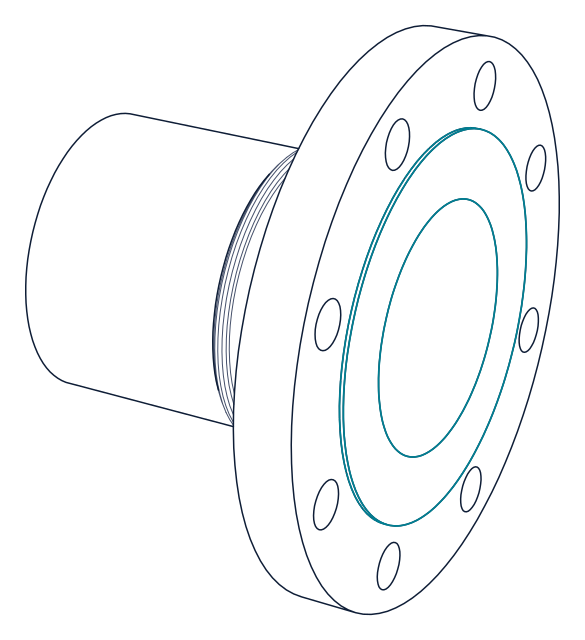
- Weld neck flange (WN)
- A flange with a long tapered hub whose end is beveled and butt welded to the pipe. The bore is machined to match the pipe, so the flow path has no step.
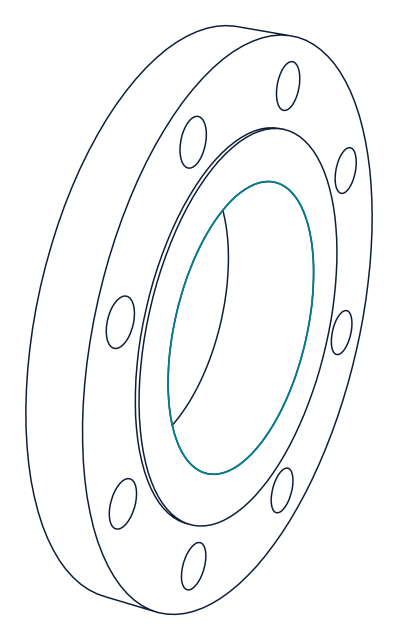
- Slip-on flange (SO)
- A flange with a plain bore slightly larger than the pipe OD. The pipe slides in, stops short of the face, and is joined by a fillet weld on the outside of the hub and another inside the bore.
| Item | Weld neck | Slip-on |
|---|---|---|
| Attachment | One full-penetration butt weld | Two fillet welds, outside and inside |
| Inspection of the weld | Radiography or ultrasonic testing is possible | Visual and surface examination; volumetric testing is impractical |
| Bore | Matches the pipe; specify the schedule or wall | Slightly larger than the pipe OD, so the flange does not set the flow bore |
| Strength under pressure | Highest; the hub spreads stress | Lower than weld neck |
| Fatigue and cycling | Preferred | Not preferred |
| Fit-up | Pipe must be cut square and beveled accurately | More forgiving; pipe can be trimmed on site |
| Length and weight | Longer and heavier because of the hub | Shorter and lighter |
| Typical use | High pressure, high or low temperature, hazardous, cyclic service | Lower pressure, utility and non-critical process lines |
Many owner specifications and codes restrict slip-on flanges in certain services. The piping class governs.
Which is stronger, and what about fatigue?
The hub on a weld neck flange moves the change of section away from the weld and spreads bending stress along the pipe. That is why weld necks are the standard choice where pressure, temperature or load fluctuates.
A rule of thumb in piping handbooks is that a slip-on flange has roughly two-thirds the strength under internal pressure and about one-third the fatigue life of a weld neck flange. This is a guide to the direction of the difference, not a design value. The piping designer calculates the flange under the applicable code.
The inside fillet weld of a slip-on also creates a small crevice where fluid can collect. In corrosive or erosive service that crevice can be a starting point for attack, which is another reason designers avoid slip-ons there.
How do welding and cost compare?
A slip-on flange costs less to buy and lets the fitter work with looser tolerances: no precise bevel, and the pipe can be trimmed to length. Two fillet welds, though, are more welding than one butt weld, and the inside weld has to be done in a confined space.
A weld neck flange needs a squarely cut, beveled pipe end and a butt weld that is often radiographed. That adds inspection cost but gives a joint whose quality can be proven.
The installed-cost gap is therefore smaller than the purchase-price gap, and it can reverse when butt welds are not radiographed. Compare both on the whole job, not on the flange price alone.
Which standards, classes and facings apply?
ASME B16.5 covers flanges and flanged fittings from NPS 1/2 to NPS 24 in Classes 150 to 2500, including weld neck, slip-on, socket weld, threaded, lap joint and blind types. ASME B16.47 covers NPS 26 to NPS 60 in two dimensional series, A and B, and covers weld neck and blind flanges, so a slip-on is not a B16.47 option. Weld necks are made across every class, while slip-ons are mostly used in Classes 150 to 600. See Flange pressure classes.
- Raised face (RF) is the common facing. The gasket seats on the raised ring inside the bolt circle.
- Flat face (FF) is used where the mating flange is flat, as on many cast iron valves and pumps. Do not mate an RF steel flange to an FF cast iron flange without engineering approval.
- Ring-type joint (RTJ) has a machined groove for a metal ring gasket covered by ASME B16.20. It is used in high-pressure, high-temperature service and is normally paired with weld neck flanges.
Match the gaskets and bolting to the facing. See Stud bolts and gaskets.
When should you choose each type?
| Condition | Prefer | Reason |
|---|---|---|
| High pressure (Class 600 and above) | Weld neck | Strength and weld quality |
| High or low temperature, thermal cycling | Weld neck | Fatigue resistance |
| Flammable, toxic or high-consequence fluids | Weld neck | Weld can be examined; fewer leak paths |
| Vibration or pulsating flow | Weld neck | Smooth stress transition |
| Corrosive or erosive fluids | Weld neck | No internal crevice; bore matches the pipe |
| Low-pressure water, air, cooling water, drains | Slip-on | Lower cost; easy fit-up |
| Non-critical lines, class and piping spec allow | Slip-on | Simpler installation |
Use the piping class and line list to confirm the final choice.
What should an RFQ specify for flanges?
Give type, size, class, facing, bore (for weld neck), standard and material in one line. For example: Flange, weld neck, NPS 6, Class 300, RF, bore SCH 40, ASME B16.5, ASTM A105.
- Type: weld neck or slip-on (WN or SO) and, for weld neck, the pipe schedule or wall for the bore
- NPS and class, with the standard (B16.5 or B16.47) and edition
- Facing and finish: RF, FF or RTJ, with the groove type for RTJ
- Material and specification: for example ASTM A105, A350 LF2 or A182 F316
- Supplementary requirements: sour service, impact testing, PMI
- Certificate: EN 10204 type 3.1 with heat numbers
- Matching gaskets and studs, if you want them in the same package
How can JJ Projects help?
JJ Projects sources flanges, studs and gaskets to specifications such as ASME B16.5 and ASTM A105, and checks the certificates against your order. Send the flange list through Request a quote, or see steel and structural products.
Sources
- ASME B16.5, Pipe Flanges and Flanged Fittings: NPS 1/2 through NPS 24
- ASME B16.47, Large Diameter Steel Flanges: NPS 26 through NPS 60
- ASME B16.20, Metallic Gaskets for Pipe Flanges
- ASME B31.3, Process Piping (flange selection and limitations)
- ASTM A105/A105M, Carbon Steel Forgings for Piping Applications
- Engineering ToolBox, ASME B16.5 flange pressure-temperature ratings