What are NACE MR0175 and ISO 15156?
- NACE MR0175 / ISO 15156
- The joint standard, "Petroleum and natural gas industries: materials for use in H2S-containing environments in oil and gas production". It sets requirements and recommendations for selecting and qualifying metals that resist cracking caused by H2S.
The text is published by ISO as ISO 15156 and by NACE as NACE MR0175. NACE International is now part of AMPP, the Association for Materials Protection and Performance, which keeps the NACE standard numbers. The 2020 edition of the three parts was current when this guide was written, and a revision was in development. Name the edition on the purchase order.
| Part | Title | Covers |
|---|---|---|
| Part 1 | General principles for selection of cracking-resistant materials | Scope, definitions, user and manufacturer responsibilities, cracking mechanisms, general rules |
| Part 2 | Cracking-resistant carbon and low-alloy steels, and the use of cast irons | Steel pipe, flanges, forgings, bolting, valve bodies, vessels, with hardness and heat treatment rules |
| Part 3 | Cracking-resistant CRAs and other alloys | Stainless steels, nickel alloys and other corrosion-resistant alloys, with limits by environment |
What is sour service, and who decides?
Sour service is service in which water and H2S are present at levels that can crack susceptible materials. Cracking needs three things together: a susceptible material, tensile stress, and a wet environment with H2S.
ISO 15156-2 uses the H2S partial pressure and the in-situ pH to define severity regions for sulfide stress cracking of carbon and low-alloy steels. A partial pressure of 0.3 kPa (0.05 psi) is the commonly cited lower boundary of the sulfide stress cracking regions, with less demanding rules below it. The standard sets the exact rules, so read the clauses and not a summary.
The standard assigns the decision to the user of the equipment. The user, not the supplier, determines the process conditions: H2S partial pressure, pH, chlorides, temperature and total pressure. A distributor cannot know your fluid, so the order should state the conditions or say that the item must comply with the standard.
What kinds of cracking does it address?
| Mechanism | What happens | Typical test or control |
|---|---|---|
| SSC, sulfide stress cracking | Brittle cracking of hard steel under tensile stress in wet H2S | Hardness limits; laboratory testing to NACE TM0177 |
| HIC, hydrogen-induced cracking | Planar cracks form inside plate or pipe steel from absorbed hydrogen, without applied stress | Clean steel; testing to NACE TM0284 |
| SOHIC, stress-oriented HIC | Stacked HIC cracks linked by stress | Material quality, weld and heat treatment control |
| SCC, stress corrosion cracking | Cracking of corrosion-resistant alloys from stress, chlorides and H2S | Environmental limits in Part 3 |
Summary only. ISO 15156 defines each mechanism and the controls that apply.
NACE TM0177 tests a metal specimen under stress in an H2S solution to see if it cracks. NACE TM0284 tests plate and pipe steels for HIC. These are laboratory methods. Whether a test is required comes from the standard, the owner's specification or a product standard such as API 5L Annex H, not from the test method itself.
What hardness limits are cited for carbon steel?
For carbon and low-alloy steels, the best-known limit is a maximum hardness of 22 HRC (Rockwell C) for the parent metal, where the hardness route is used. Hardness is a proxy for susceptibility: harder steel cracks more readily in H2S.
That figure is a summary, not the full rule. The standard sets how hardness is measured and where, separate limits for welds and heat-affected zones, the need for post-weld heat treatment, exceptions and alternative qualification routes. ISO 15156-2 is the authority, and the edition on the order governs.
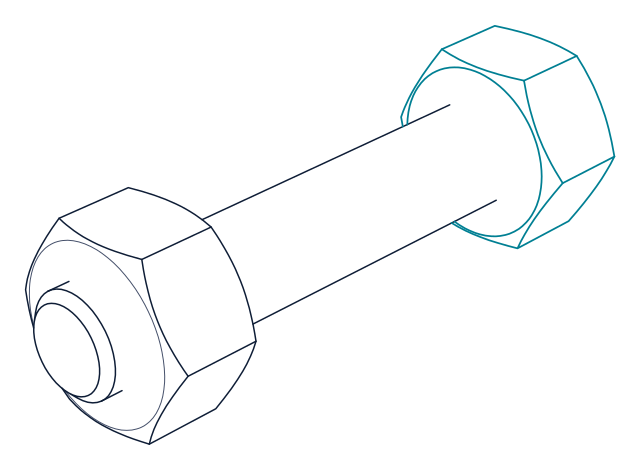
Bolting shows why this matters. ASTM A193 B7 studs can be harder than sour service limits allow. Specifiers choose A193 B7M studs with A194 2HM nuts, which are produced to a controlled maximum hardness. See Stud bolts and gaskets.
What is the buyer's role?
| Party | Responsibility |
|---|---|
| Equipment user or purchaser | Defines the environment, names the standard and edition, and states sour service on the order |
| Manufacturer | Selects and produces material that meets the standard, controls heat treatment, tests hardness and issues the records |
| Distributor or sourcing agent | Passes on the order requirements and the manufacturer's documents, and keeps heat traceability |
| Inspector | Witnesses tests or reviews records when the order requires it |
- Name the standard and edition: for example ISO 15156-2 or NACE MR0175 / ISO 15156, edition year.
- Give the service conditions, or state that the item must meet the standard without further limits.
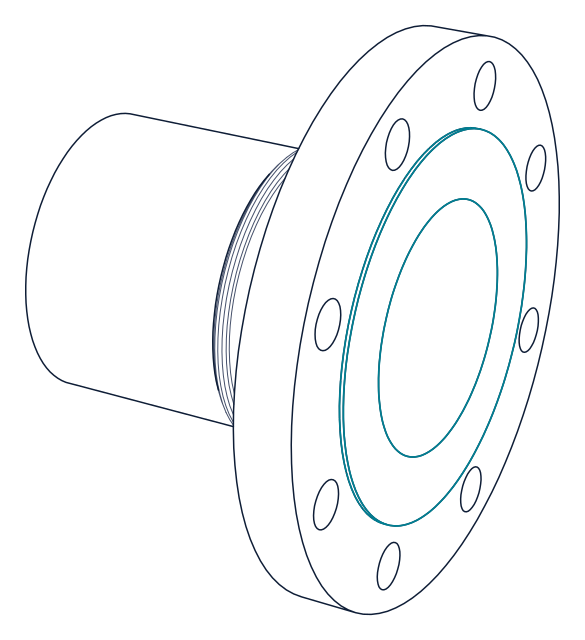
- Cover every wetted and pressure-boundary part: pipe, flanges, fittings, valves, bolting and gaskets metal parts.
- Require a compliance statement from the manufacturer, and the hardness results, heat treatment and heat number on an EN 10204 type 3.1 or 3.2 certificate.
- Name a third-party inspector for 3.2 when the owner requires it.
See Material test reports for how to check the certificate against the order.
How can JJ Projects help?
JJ Projects does not certify materials to NACE MR0175 / ISO 15156. It sources items to the specifications you name, requests the manufacturer's compliance statement and test records, and checks them against your purchase order. State sour service in your Request a quote, or see steel and structural products.
Sources
- ISO 15156-1:2020, Materials for use in H2S-containing environments in oil and gas production, Part 1: general principles
- ISO 15156-2, Cracking-resistant carbon and low-alloy steels, and the use of cast irons
- ISO 15156-3, Cracking-resistant CRAs (corrosion-resistant alloys) and other alloys
- AMPP (formerly NACE International), standards catalogue: NACE MR0175/ISO 15156, TM0177, TM0284
- TWI, NACE TM0177 sour test methods
- Texas Flange, NACE MR0175 flanges for sour service